
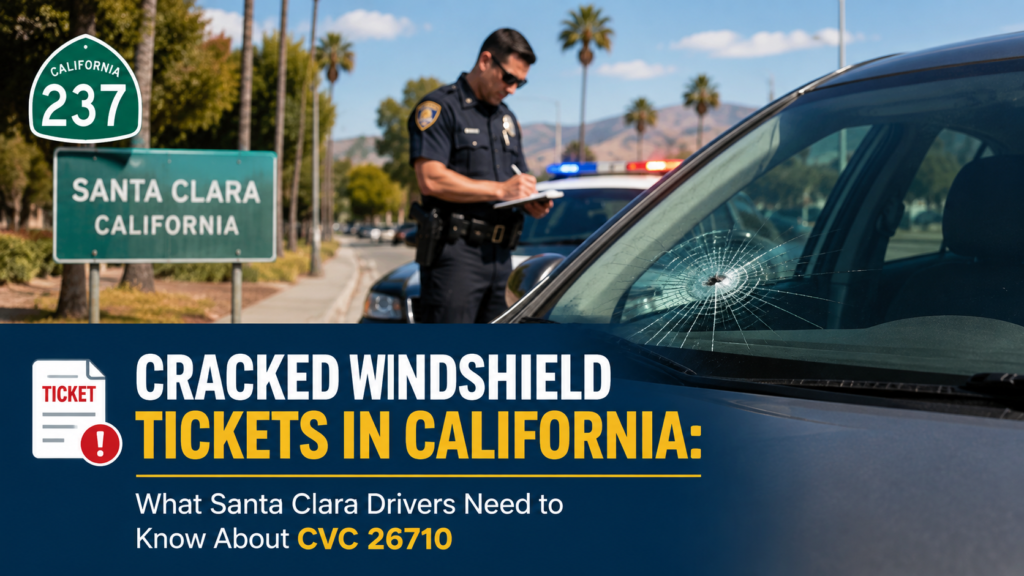
A Cracked Windshield Ticket in Santa Clara is more than an aesthetic problem. California Vehicle Code Section 26710 establishes a specific legal standard for windshield condition, and drivers who fail to meet that standard can receive citations from the California Highway Patrol, Santa Clara Police Department, or other law enforcement agencies. Understanding exactly what the law says, what constitutes a violation, what happens when you receive a ticket, and how to resolve it efficiently saves Santa Clara drivers time, money, and stress. This guide covers everything you need to know.
What California Vehicle Code Section 26710 Says
California Vehicle Code Section 26710, titled “Defective Windshields and Rear Windows,” states: “It is unlawful to operate any motor vehicle upon a highway when the windshield or rear window is in such a defective condition as to impair the driver’s vision either to the front or rear. In the event any windshield or rear window fails to comply with this code the officer making the inspection shall direct the driver to make the windshield and rear window conform to the requirements of this code within 48 hours.”
Several important legal points flow from this statutory language. First, the law does not specify a crack length, size, or location as an absolute bright-line threshold the standard is whether the condition “impairs the driver’s vision.” This means officer discretion plays a significant role. An officer who believes a crack obstructs or impairs the driver’s clear view of the road can issue a citation regardless of whether the crack is long or short. Second, the law specifies a 48-hour compliance window from the time of citation, within which the driver must repair or replace the windshield to bring it into compliance. Third, the officer may also arrest the driver and require them to appear in court and produce evidence of correction.
California Vehicle Code Section 26708 is a related provision that prohibits placing, affixing, or applying any material to the windshield or side windows that obstructs the driver’s view. This section applies to aftermarket tinting, suction cup mounts, stickers, and other objects that block the driver’s sightline not typically to cracks but it operates alongside CVC 26710 as part of California’s legal framework for maintaining driver visibility.
What Types of Windshield Damage Are Citable in Santa Clara
Because CVC 26710’s standard is vision impairment rather than a specific damage size, Santa Clara drivers should understand the practical factors that influence whether a particular crack is likely to result in a citation. Cracks directly in the driver’s line of sight the zone directly in front of the steering wheel through which the driver views the road are the most likely to be cited because an officer assessing visibility impairment will naturally focus on this zone. Any crack that creates visual distortion, refraction, or obstruction in this zone is a candidate for citation.
Large cracks that span a significant portion of the windshield are citable even if they are not directly in the driver’s line of sight, because they may propagate into the vision zone and because they structurally weaken the windshield in ways that create safety risk beyond pure visibility. West Coast Trial Lawyers notes that cracks larger than 14 inches are specifically highlighted as concerns under California law’s application of CVC 26710.
Cracks at the windshield edge are both a legal and structural concern. Edge cracks propagate rapidly the glass near the edge is under greater thermal stress, and cracks that reach the edge can spread across the full windshield in response to temperature changes, road vibration, or a subsequent small impact. Santa Clara’s temperature variation between cool bay-influenced nights and warm afternoon temperatures creates thermal cycling that accelerates edge crack propagation.
Santa Clara, San Jose, Sunnyvale, and surrounding Bay Area cities present specific windshield damage patterns driven by the region’s freeway network and construction activity. Driving US 101 through Santa Clara during the ongoing construction of the new Caltrain grade separations, navigating the interchange at I-880 and I-237, or commuting on routes with heavy truck traffic creates above-average chip and crack exposure. Once damage occurs, the Santa Clara climate with its marine influence, cool mornings, and warm afternoons creates thermal cycling conditions that can rapidly propagate small chips into larger cracks if they are not promptly repaired.
What Happens When You Receive a Cracked Windshield Ticket in Santa Clara
A cracked windshield citation in California is typically a “correctable violation” also called an equipment fix-it ticket. Under California Penal Code Section 40610, when a citation is issued for certain equipment violations including windshield defects, the officer can note that the violation is correctable. If the driver corrects the violation and has the correction certified by a law enforcement officer or the court, the court may dismiss the citation upon payment of a reduced administrative fee.
The fine structure for a cracked windshield citation in California reflects the correctable violation framework. The base fine is typically $25 to $50, but California’s penalty assessment system adds multiple surcharges on top of the base fine. Total financial exposure with all assessments generally ranges from $100 to $200 depending on the specific jurisdiction and court. However, if the citation is dismissed after correction, the financial consequence is typically just the court administrative fee (commonly around $25), making prompt repair and proper documentation of correction the most efficient resolution path.
The 48-hour correction window specified in CVC 26710 is the critical time period. Within 48 hours of receiving the citation, the driver must have the windshield repaired or replaced. Then, the correction must be certified by a law enforcement officer who signs off on the correction notice, or the driver may be required to appear in court with evidence of correction. Keep the receipt from your repair or replacement service as documentation of when and how the correction was made.
How to Dismiss a Cracked Windshield Ticket in Santa Clara
The process for dismissing a correctable windshield violation in Santa Clara County courts is straightforward when handled promptly. After having the windshield repaired or replaced, obtain signed certification from a law enforcement officer (typically at a police station or CHP office by appointment) that the windshield has been brought into compliance, or attend your court date with proof of repair including the dated receipt from the auto glass service.
The court imposes an administrative fee for dismissal of correctable violations in Santa Clara County this is typically in the $25 to $65 range, significantly less than the full citation penalty. Failing to respond to a citation or failing to correct the violation results in escalation: the violation becomes a non-correctable citation, the full fine amount plus assessments applies, and failure to appear can result in a license hold through the DMV.
The Safety Case Beyond the Legal Requirement
While CVC 26710 provides the legal framework for cracked windshield enforcement in Santa Clara, the underlying safety rationale for the law is equally important. A windshield is a structural component of the vehicle it contributes to the rigidity of the passenger compartment in rollover accidents, where a properly bonded and structurally intact windshield prevents roof collapse. It serves as the backstop for the front passenger airbag, which inflates toward the windshield and rebounds to cushion the occupant in frontal impacts. A cracked windshield, particularly one with extensive damage or edge cracking, compromises these structural functions.
Beyond structural concerns, visual impairment from a cracked windshield is an active safety risk. Light refracting through crack patterns creates visual distortion. In Santa Clara’s morning commute conditions when low sun angles create glare that is amplified through damaged glass a crack in or near the driver’s sightline can be significantly more disruptive to clear vision than it appears in neutral lighting.
Common Questions About Cracked Windshield Tickets in Santa Clara
Can I get a ticket for a small chip that is not in my line of sight in Santa Clara? Officer discretion is the operative standard under CVC 26710. A small chip outside the driver’s direct sightline is less likely to result in a citation than a crack in the sightline, but it is not exempt from citation if an officer determines it impairs vision or creates a safety concern. The more practical concern for small chips is that they will propagate Santa Clara’s thermal cycling converts many small chips into larger cracks over weeks or months.
Will a cracked windshield affect my smog check in California? No. California smog inspections focus exclusively on emissions and do not evaluate windshield condition. A cracked windshield will not cause a smog check failure. However, this does not eliminate the legal or safety concerns associated with driving with a damaged windshield.
What is the fastest way to resolve a cracked windshield ticket in Santa Clara? The fastest path is immediate scheduling of windshield repair or replacement mobile auto glass services in Santa Clara can often respond same-day or next-day. After service is completed, obtain the dated receipt, have the correction certified by law enforcement if required by the citation, and submit documentation to the court. The entire process, from receiving the ticket to having it dismissed, can be completed within a few days if acted on promptly.